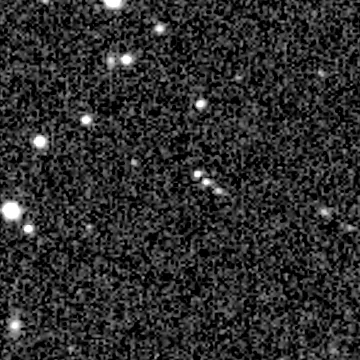
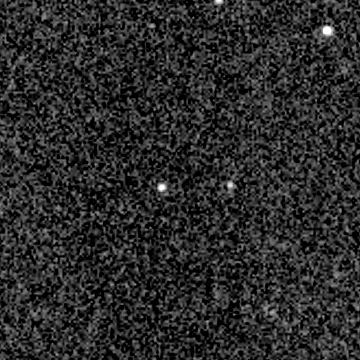
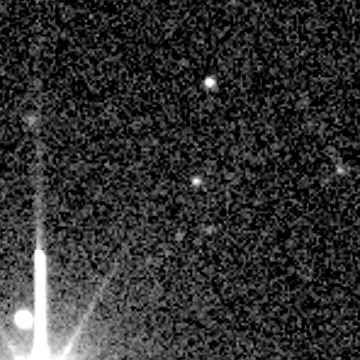
An earlier photo
The earliest observation now associated with Beebe predates its discovery by five years. An earlier observation linked to an object later is called a precovery.
FOR FAMILY, FRIENDS & THE CURIOUS
In 2026, an asteroid was named after Wilson Beebe. This is a place for family and friends to see it in telescope photos and learn a little about it.
Press play to compare the photos. The circle shows where Beebe is expected to be.
How it got the name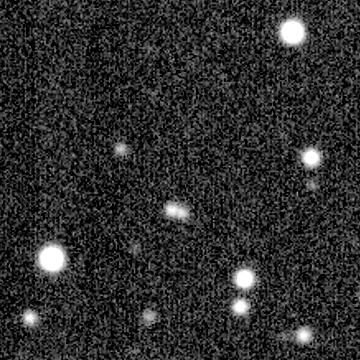 N ↑
N ↑Each frame is a real telescope exposure of the same patch of sky. Stars stay approximately in place; an asteroid moves. The circle follows Beebe’s predicted location, not a measured detection. Images use g, r filters, so stars may change brightness between frames. These images do not show Beebe’s surface.
Open this source FITS imageRECENTLY ADDED
New photos are added as they become available. The observing date is when the telescope took the photo; the added date is when it appeared on this site.
WHY BEEBE?
The asteroid was discovered in 1997 and received its name in 2026. The name recognizes Wilson’s work on software for astronomy.
Read the official naming recordThe earliest observation now associated with Beebe predates its discovery by five years. An earlier observation linked to an object later is called a precovery.
Eric W. Elst discovered the asteroid at La Silla Observatory in Chile. Its first designation was 1997 GA40.
The name honors Wilson Beebe, whose software helps find faint objects beyond Neptune by aligning and adding survey images—a technique called shift-and-stack.
Wilson Beebe (b. 1993) is an American researcher at the University of Washington, where he develops software for discovering faint trans-Neptunian objects with novel shift-and-stack techniques in large astronomical survey image data, especially the NSF-DOE Vera C. Rubin Observatory’s Legacy Survey of Space and Time.
WGSBN Bulletin 6, no. 11, p. 10 · 9 July 2026
ABOUT THE ASTEROID
Beebe is one of many asteroids between Mars and Jupiter. Its name gives us a good reason to learn about one of them.
Beebe travels around the Sun in a gently oval orbit, tilted about 13.5° from Earth’s orbital plane. JPL classifies it as a main-belt asteroid, not a near-Earth asteroid.
One astronomical unit (au) is about the distance from Earth to the Sun. It is a handy unit for these very large distances.
SIZE
We don’t have a measured diameter. A size estimate depends on how much sunlight its surface reflects. Try the slider: a darker asteroid would need to be bigger to look as bright.
For absolute magnitude H = 13.87, diameter D = 1329 × 10−H/5 / √p, in kilometers. The illustrative reflectivity range of 5.7–25% implies about 4.5–9.4 km. It is not a confidence interval. No diameter or reflectivity is listed in the current JPL record.
ITS SPIN
A published lightcurve suggests Beebe rotates once in about 3 hours. But the coverage was incomplete: the period may be wrong by roughly 30%.
A lightcurve records changing brightness as an object turns. The current JPL entry reports 2.99603 hours, from TESS photometry via the Lightcurve Database.
DISTANCE FROM EARTH
Prediction for
RA 01 36 17.28
Dec +06 18 51.0
Predicted V magnitude 18.27
As seen from Earth’s center. Far too faint for unaided eyes. Retrieved 2026-09-29.
JPL solution 60 · computed 2026-03-12 15:25:58 · epoch JD 2461200.5 · equinox J2000. Sigmas are the values returned by JPL; see its documentation for interpretation.
| Element | Value | Reported σ | Unit |
|---|---|---|---|
| semi-major axis | 2.73997997 | 8.387e-10 | au |
| aphelion distance | 3.00471400 | 9.198e-10 | au |
| eccentricity | 0.0966189678 | 8.052e-10 | — |
| inclination; angle with respect to x-y ecliptic plane | 13.5289060 | 4.130e-8 | deg |
| mean anomaly | 178.815014 | 5.362e-7 | deg |
| mean motion | 0.217311642 | 9.978e-11 | deg/d |
| longitude of the ascending node | 188.510177 | 1.481e-7 | deg |
| sidereal orbital period | 1656.60706 | 7.606e-7 | d |
| perihelion distance | 2.47524593 | 2.852e-9 | au |
| time of perihelion passage | 2460377.65 | 2.126e-6 | TDB |
| argument of perihelion | 350.828679 | 2.968e-7 | deg |
4,729 observations used by JPL; fit arc 1992-04-07 to 2025-09-24; RMS residual .43671 arcseconds; condition code 0. Fit residuals are not a guarantee of future prediction accuracy. Earth MOID: 1.47919 au, a distance between orbital paths, not today’s distance.
The downloaded file contains 5,117 text records, including 750 satellite-position continuation records. These are counted separately. JPL’s orbit-fit count uses a different record selection/counting context.
Choose a date to view the photos, play a sequence, or download a copy.
Browse telescope photos